


What You Get When You Engage Insight RI
The inspection takes a few hours. The report works for years. Here is exactly what lands in your inbox within two business days of our inspector leaving your roof — section by section, with nothing left vague. If you are comparing us against another provider, put this page next to their sample report and decide for yourself.
The Report Is the Product
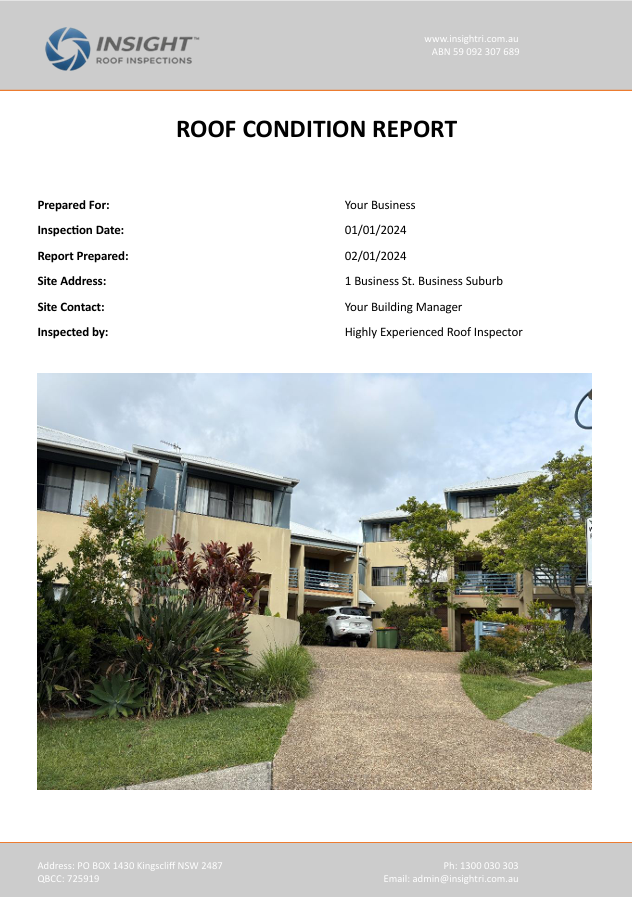
Most inspection providers treat the report as an afterthought — a summary of the site visit, produced quickly, padded with photos. We treat it the opposite way. The site visit exists to feed the report, because the report is what you will actually use: to brief your committee or board, to procure contractors, to challenge a quote, to support an insurance claim, or to hold a contractor to their warranty. Every element below exists because a strata manager, facilities manager, or asset manager needed it to make a defensible decision.


Inside Every Insight RI Report
1. Executive Summary and Roof Condition Snapshot
The first two pages give you the whole picture: an overall condition rating, the defect count by priority, and a remaining serviceable life assessment — in plain English, written for a committee or board, not for an engineer. If you need to justify a maintenance decision to people who will never read past page three, these are the pages that do it.


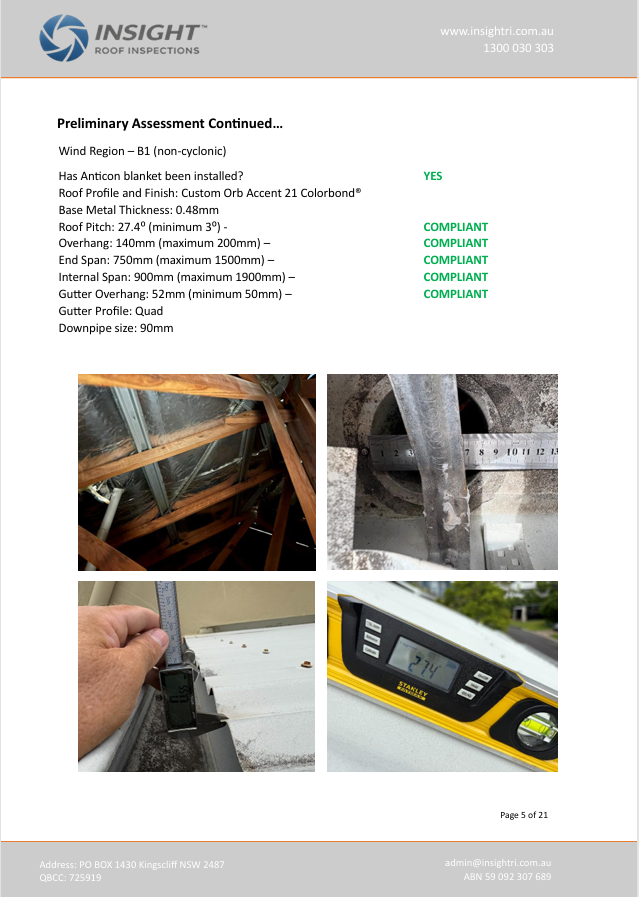
2. Preliminary Assessment — Measured Compliance Data
Before a single defect is documented, we record what is actually on your roof, measured on the day: roof profile and pitch, base metal thickness, gutter profile, downpipe sizing, overhangs — each checked against the relevant Australian Standard or manufacturer specification. This is where systemic problems get found. Under-sized downpipes or a pitch below the minimum for the profile can explain years of "unfixable" leaks that reactive maintenance never solved.
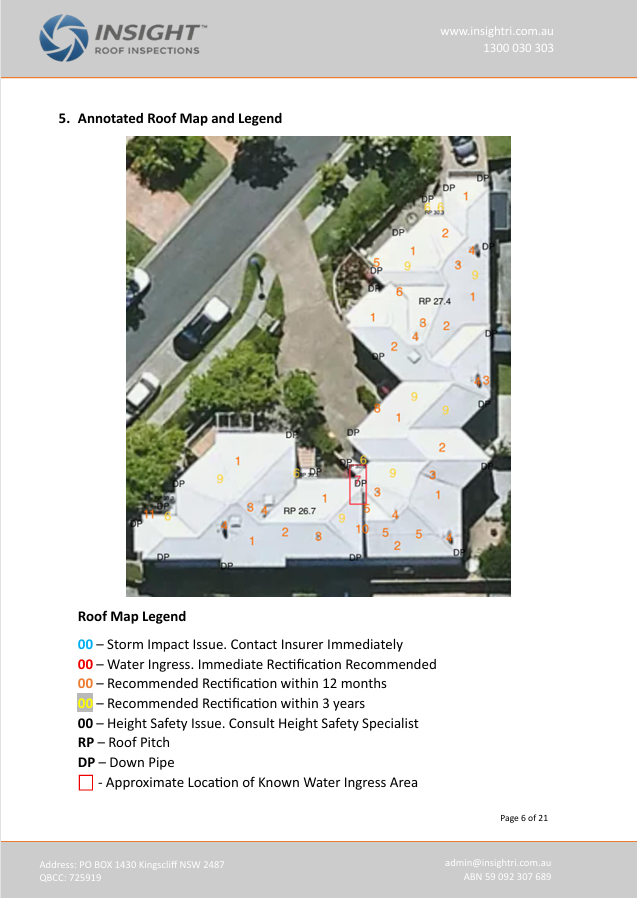
3. Annotated Roof Map
A top-down map of your roof, built from current drone or satellite imagery, with every defect marked by its reference number. Anyone who was not on the roof — your committee, your contractor, your insurer — can see exactly where every issue sits. Contractors quote faster and more accurately when they are not guessing at locations.
4. The Defect Register
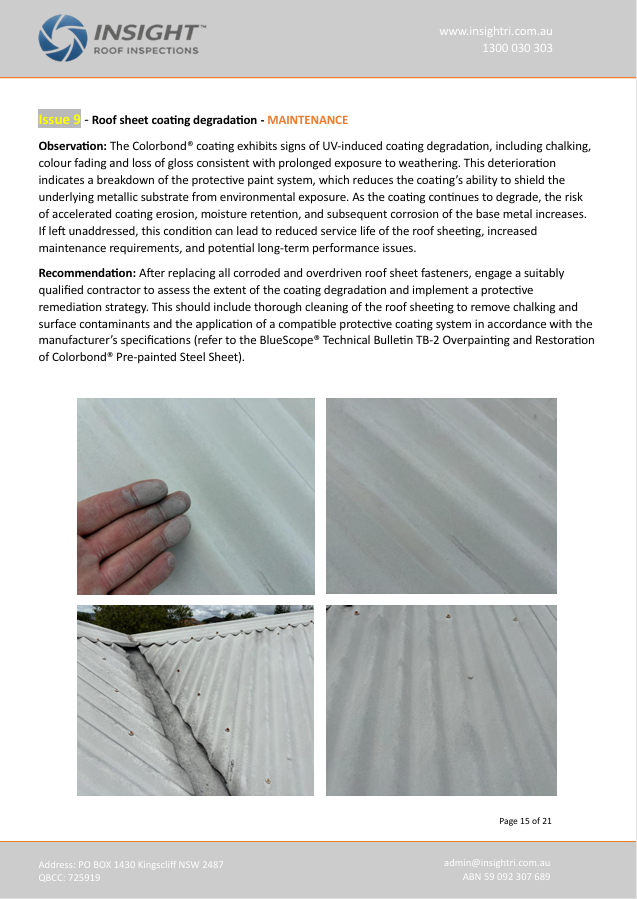
Every defect gets a unique reference number, a written observation, a high-resolution photograph, a location on the roof map, and a priority classification. No vague "general wear noted." If a finding represents a departure from an Australian Standard, the specific clause is cited — which means a contractor disputing the finding is disputing the standard, not our opinion.
5. Prioritised Scope of Works — With Quantities
A colour-coded rectification scope, ordered by priority, with measured quantities for every line item. This is the document you hand to contractors for quoting — and because we do no repair work and hold no contractor relationships, it is a genuinely neutral brief. Every contractor quotes against the same defined scope, which means for the first time their quotes are actually comparable.
6. Indicative Cost Estimates
Estimated rectification costs for each defect, referenced to current, region-specific market rates and tied to no contractor or supplier. This is your benchmark for evaluating quotes and your input for CapEx planning and sinking fund modelling. When a quote comes in at three times the indicative figure, you will know to ask why.
7. Australian Standards Appendix
Every non-compliant finding is backed by an appendix reproducing the relevant standard extract or diagram — SA HB 39:2015, AS 1562.1, AS 4654.2, AS/NZS 3500.3 and others as applicable. When a contractor pushes back on a finding, you are not defending an opinion. You are pointing at a published requirement they are already on notice about.
What This Document Does in the Real World
A community housing provider managing a large Western Sydney portfolio engaged us after persistent leaks continued despite significant waterproofing works having been invoiced and paid. Our report documented — with photographs, measurements, and standards references — that membrane installation the contractor had invoiced was never completed across significant areas of the roof. The report was specific enough, and independent enough, that the contractor agreed to redo the defective works at no cost. The community housing provider has since commissioned inspections across sixteen additional sites.
That outcome was not produced by the inspection. It was produced by the report — and every section described on this page is the reason it held up.
How the Engagement Works
One: you request a proposal — send us the address and anything you know about the roof, and we return a fixed fee proposal, usually on the day or within one business day at the latest. Two: we inspect — typically within two to three weeks of engagement, two to four hours on-site for most commercial roofs, with priority scheduling available for active leaks and post-storm damage. Three: your report is delivered as a structured PDF within two business days of the inspection. Fixed fee, agreed before we start. No variations, no surprises, no upsell — because we have nothing else to sell you.
What It Costs
Fees are based on roof area, starting at $1,200 (ex-GST) for roofs 150m² to 300m² and scaling with size. Everything described on this page is included in every report — there is no premium tier where the roof map or the cost data costs extra. For a full breakdown, see our commercial roof inspection cost guide, or request a proposal for your specific building.
See One for Yourself
The fastest way to evaluate us is to read what we produce. Contact us and we will provide a sample report relevant to your building type — full example reports are not publicly downloadable to protect client confidentiality, but we are happy to share an appropriate example on request. Then put it next to the last roof report you received and compare.
Insight RI provides independent commercial roof inspections across NSW and South East Queensland. We carry out no repairs, hold no contractor relationships, and receive no commissions. The report described on this page is our only product — which is exactly why it is built the way it is.